
The Untapped Workforce
The statistics are stark, and they tell a story of massive untapped potential.
Across the globe, neurodivergent individuals—particularly those on the Autism Spectrum—face an employment crisis that has little to do with ability and everything to do with environment.
In the United Kingdom, Office for National Statistics (ONS) data have historically shown that just 29% of autistic adults are in any kind of employment, the lowest rate of any disability group.
The situation mirrors trends in the United States and globally. Estimates suggest that nearly 85% of autistic college graduates are unemployed or underemployed.
This isn't a lack of talent; it is a lack of fit. Traditional workplaces—replete with fluorescent lights, ambiguous social hierarchies, and relentless small talk—can be minefields for the neurodivergent mind.
However, when the environment shifts from a corporate boardroom to a kennel, a grooming salon, or a training field, the narrative changes entirely.
The Neurodiversity Gap
- 85%: Estimated unemployment rate for Autistic adults with a college degree in the US.
- 29%: Percentage of Autistic adults in the UK currently in paid employment.
- The Solution: Industries that value focus, empathy, and non-verbal communication—like Animal Care—are proving to be a vital bridge to meaningful employment.
Some studies point to jobs with animals as being a phenomenal pairing for lots of neurodivergents. This is especially true for jobs that limit the need for masking, which can be exhausting.
An increase in perception and deep empathy can often be traits of—and deep feeling often leads to—an understanding of dog behaviors that many neurotypicals might miss.
Leading to some perfect job fits like that of successful business owner Kay Clarke, who, after a lifetime of struggling to feel a fit or purpose in life, found that purpose in dogs and in grooming.
Meeting Kay Clarke
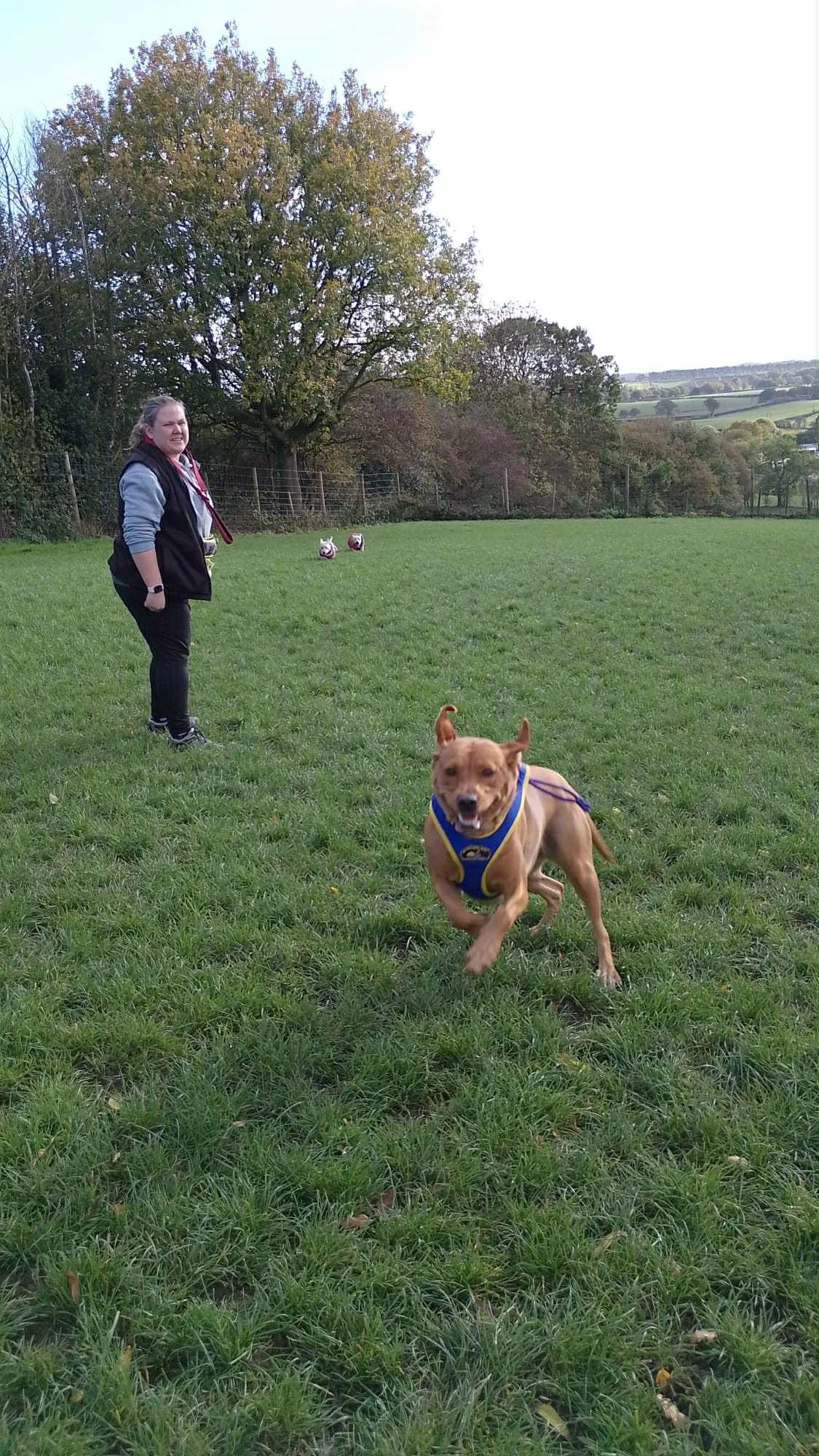
Our Editor, Greg, sat down with Kay Clarke, a Nottinghamshire, UK Dog Groomer, to learn more about how dogs have affected her journey with mental health and spectrum disorders.
Kay will be contributing to K9Magazine.com on a regular basis as a columnist focusing on the relationship between human mental health and dog mental health, and we can't wait to see what she brings to our family. We know she will do great!
Kay and I are related—she's my second cousin, or perhaps first cousin once removed (our parents are cousins, let’s leave it at that!)—but regardless of the family tree, we are family.
"I think my ADHD/Autism is a super power in this job... I listen to my instinct."
I knew that she had navigated life with a spectrum disorder, was passionate about dog behavior, and had built a career as a self-employed dog groomer.
Kay feels like finding a job with dogs allowed her to find a life-altering passion that also happens to be the perfect fit for the unique abilities resulting from her ADHD-Autism experience.
We met at a local pub to discuss how dogs and spectrum disorders overlap.
As often occurs when two neurodivergents get together with a shared passion, we chatted for a good 30 minutes about the state of the dog universe and the unfair state of veterinary affordability before getting to the meat of our conversation.
But get there, we did!
Greg: Thanks so much for talking to K9 Magazine, and welcome to the family! Let me take a step back and ask about your early life with dogs.
Kay: Thank you, excited to be here! I always felt I was at peace when around dogs, although we never had them until I was a teenager. I finally convinced my mum and dad to get Max, a Border Collie who was my first dog.
Until then, I'd walk miles to visit my grandma's Shih Tzus or around the block to see my cousin, only to spend hours paying more attention to their dog! I'd find any excuse to be around dogs.
From being young at school, I can remember being really anxious, hating social interactions, and finding chit-chat really difficult. Everyone told me I'd grow out of it, but I just never felt better.
By 18, I was having these nocturnal panic attacks where I'd wake up with pins and needles all over, finding it difficult to breathe. Once, my parents called for an ambulance in the middle of the night.
The paramedics took my vital signs, and after confirming that I was physically okay, they told me it was panic, have a hot chocolate, and go back to sleep! It got worse from there.
The closer it got to bedtime, the more panicked I became until my bed just became a trigger. It was awful. My anxiety got so bad at one point that I couldn't eat without throwing up.
I ended up in A&E one night and was told that my organs would shut down if I didn’t eat soon. I spent weeks drinking milkshakes to get enough calories.
I struggled to keep anything down, or my body refused to swallow. I had a urine test done, and I was severely dehydrated and had blood in my urine.
Greg: I bet.
Kay: After school, a bit later, I started to self-medicate with alcohol until I almost developed a problem.
It slowed my thoughts down, which is a great feeling, especially for socializing, and that's why you can become dependent on alcohol and drugs quite easily, especially if you're neurodivergent.
I noticed that was becoming an issue, and now I avoid alcohol. But I still couldn't find a solution to anxiety, even after being put on different antidepressants.
Greg: What was happening in your life at that time? Was there anything particularly stressful happening?
Kay: Yeah, I had lots of coursework, but I still graduated.
Greg: I forgot, where did you go to college?
Kay: I studied Animal Management at Brackenhurst College, a part of Nottingham Trent University. Before I got a diagnosis, they had us all do an English and Math test and concluded that I needed more support with coursework to keep me on track.
Greg: That's incredible, what amazing support!
(Our conversation gets interrupted by Sandy the dog, who was excited to say hi to other dogs in the pub. Kay naturally fell into unofficial dog trainer mode and suggested that I take a small bed around with me that can be used to teach her "place" command wherever she is... thanks, Kay! Back to our conversation...)
Greg: So, before you were aware of your diagnosis, what was your experience with neurodivergence?
Kay: Well, I didn't have a name for the ADHD/Autism spectrum disorder that I would eventually be diagnosed with, but it felt like just not feeling comfortable in my skin, and I was especially uncomfortable with human interactions.
When you get me talking about dogs or another topic that I'm passionate about, the filter comes off, and I don't stop—I go on autopilot! But general chit-chat? That, I'm not naturally good at.
Greg: Wow, I see.
"Without dogs, I wouldn't feel like I had a purpose."
Kay: I've had bad experiences with small talk, so I learned to think sentences through before I said them. I talk slower, or I'll stutter, but I'm proofreading what I'm about to say for appropriateness. I think about the person and location before I speak.
Greg: Do you consciously do that?
Kay: No, it's automatic now. It's become an ingrained coping mechanism.
Greg: Wow! How has the NHS helped?
Kay: Well, I got my ADHD/Autism diagnosis, and I'm in a queue waiting for further help, just, you know, to do life! I'm approved for a life coach to help me with day-to-day life responsibilities.
Greg: There's no great system, is there? In the US, you'd go bankrupt getting a diagnosis and then getting treated, whereas here in the UK, you get the help eventually!
Kay: Exactly. I've had to help myself out with coping mechanisms that I learn online, or things you can buy to help with your experience.
I have several pairs of these "Loop" ear buds, and they're great at blocking out background noise, like in the pub now, or I can completely get rid of the noise. Before these, I used to get pounding headaches for hours after visiting somewhere noisy.
Greg: How do you feel after a long day of interactions with dogs? How tired and overstimulated are you?
Kay: It's much easier for me to be around dogs all day, and I can feel when we BOTH need a break. I try to keep the dogs below their threshold for reactivity, and that way, neither of us gets stressed.
You get to know the dog, and I can adjust my pressure slightly or move with the dog to ensure they don't feel any discomfort. So all in all, I think my ADHD/Autism is a superpower in this job, because I just feel really in tune with the dog.
By listening to my instinct, I've never had a dog issue that I couldn't handle.

Greg: Speaking of, would you ever deny a dog service for behavior?
Kay: No, not as long as the owner is honest with me. A lot of owners are conditioned to lie because groomers won't take on their dog, which can be for many reasons: the groomer's physical health, previously bad experience (been bitten/attacked).
A lot of groomers and trainers prefer an aggressive dog to a nervous/reactive dog, because aggressive dogs tell you their intent, whereas nervous dogs have unpredictable triggers.
I feel the opposite. I'd much rather work through a dog's previous bad experience and adapt to their fears. When I'm shaving around the bum area, a common trigger for nervous dogs, I take extra care to work with the dog's body language.
But no, I've never had to and won't turn a dog away for behavior; I just need honesty.
The only times I’ve had to end a groom only half done is when it becomes unsafe for the dog and me, and I don’t want the dog to be pushed past its threshold to where it’ll go into survival mode, fight/flight/freeze.
I would rather have the dog back in another day to finish the groom. My most common dogs that I’ve been unable to do a full groom on are elderly dogs.
A lot of them end up suffering with what I call doggy-dementia; they get very confused with what’s going on and will panic and threat.
The more you try and keep them still, the more they panic, and stress isn’t good for an elderly dog. A lot of elderly dogs can be blind and deaf, more scary for them.
Greg: What would you do without dogs, Kay?
Kay: I've no idea! Dogs are my identity. (Kay points to her sweater that implies she's owned by her dog, and not the other way around.) Without dogs, I wouldn't feel like I had a purpose.
Greg: It's clear to me how much dogs have helped you, and how living a life with dogs both at work and at home has lifted your mental health tremendously! But what does neurodivergence bring to dogs?
Kay: Well, apart from all the learning that I'm always doing because of my hyper-focusing, I think I just understand dogs as dogs. So many people over-humanize dogs, and it leads to issues.
I can tune in to what the dogs are feeling. If they don't like something or do like something, I will cater the groom to them specifically. I often tell the owners what they do and don't like!
"Aggressive dogs tell you their intent, whereas nervous dogs have unpredictable triggers. I'd much rather work through a dog's previous bad experience."
Greg: You're absolutely right. I've had reactive dogs, and they'd fight occasionally, and my first thought would be, "But that's your sister," but that's just not how dogs work.
In that moment, they think they're fighting for their life... they are not thinking sweet thoughts in that moment!
If you have any advice for others, neurodivergent or otherwise, who would like to get into grooming or any other dog-facing jobs, that would be great.
Kay: Absolutely. I'd tell people to do it, don't just think about it. Getting your job aligned with your values and your health is very important.
I got into it through a lot of volunteering and a college course in Animal Management, and had to go private for my dog grooming training and qualifications. which I assume most countries and cities have some version of.
A lot of people volunteer and get experience that way. I would avoid the big chain groomers unless you can ensure that the speed of work and the sound and light simulation are acceptable to you.
Finding Your Path in the Animal World
If Kay’s story resonates with you, or if you are looking to pivot into a career that values intuition and empathy over social performance, there are pathways available globally.
For Experience & Volunteering:
- UK: The Dogs Trust and RSPCA offer robust volunteering programs that can serve as a soft entry into animal care. For those looking for certifications, City & Guilds offers widely recognized vocational qualifications in Dog Grooming and Animal Management, available at colleges across the country (similar to the course Kay took).
- USA: The American Kennel Club (AKC) offers a "Junior Showmanship" program, which is excellent for younger individuals to build confidence. For adults, Paws With A Cause and similar service dog organizations often need foster families and volunteers, providing high-level exposure to dog behavior.
- Global: Apps like Rover or Wag! allow individuals to dip their toes into dog walking or sitting on their own schedule, allowing for a "low-masking" work environment that is self-paced.
Specialized Programs:
There is a growing movement of organizations specifically dedicated to connecting neurodivergent individuals with animal careers.
In the US, programs like N.E.A.D.S. (World Class Service Dogs) have educational partnerships, and the Exceptional Pets Foundation focuses on the bond between special needs individuals and animals.
In the UK, Animals for Therapy often looks for handlers who possess that unique, calm empathy that Kay describes as her superpower.
Whether it is through a formal college course in Animal Management or simply volunteering at a local shelter to walk high-anxiety dogs, the opportunities are there.
As Kay proves, the dog world doesn't just need more workers—it needs the unique superpowers that neurodivergent minds bring to the table.
